May 15, 2009

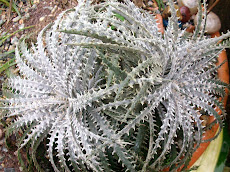
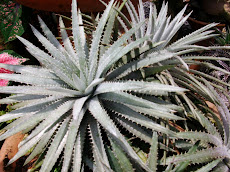
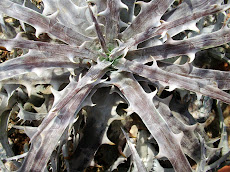
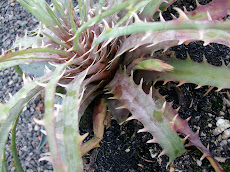
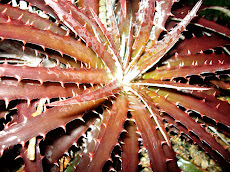
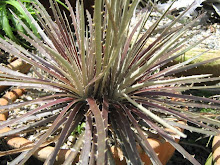
Dyckia sp Santa Catarina


This rare unknown species is an absolutely gorgeous one.
Olive and silver with small red spines.


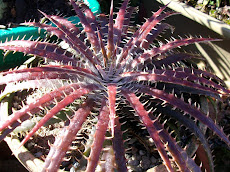
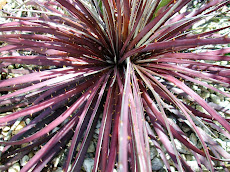
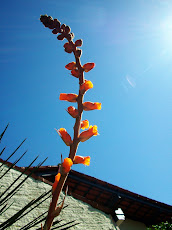
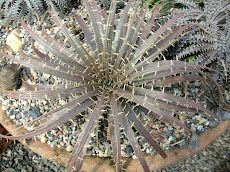
Dyckia sp Northeastern Santa Catarina


This is another nameless new species from Northeastern Santa Catarina.
This species has a curiosity, it grows on the termite nests and all the individual plant was
growing on termites nests.
Flowers are deep orange.
An extremely rare plant.


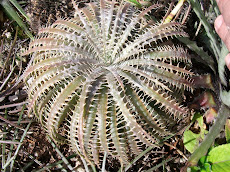
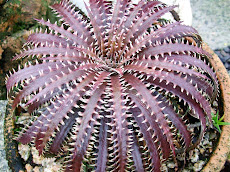
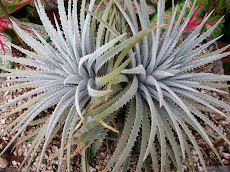
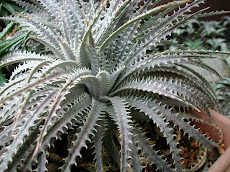
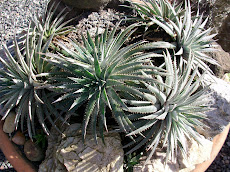
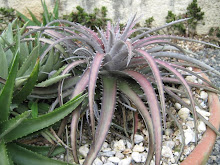
Dyckia hebdingii affinis


This plant should be called Dyckia hebdingii grandis for being bigger than
the true Dyckia hebdingii. It is another close related to hebdingii. It belongs to the
Dyckia hebdingii complex. Comes from the Dyckia triangle in Rio Grande do Sul.
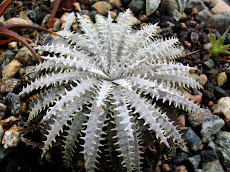
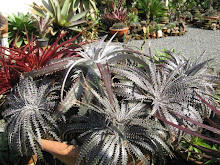
New and absolutely gorgeous Dyckia wit a most compact form.
They do look like spiny balls.


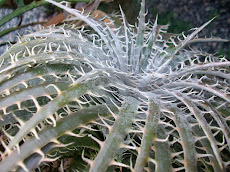
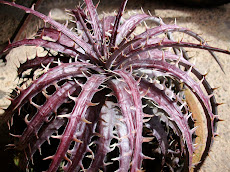
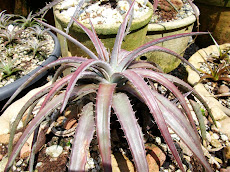
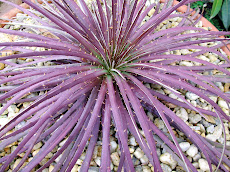
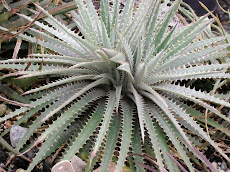
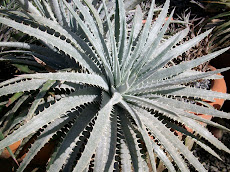
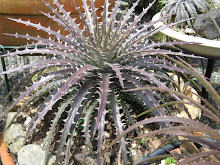
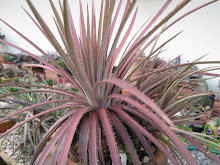
Dyckia sp hebdingii related - RS


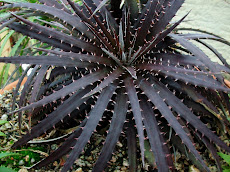
This beauty looks very alike Dyckia hebdingii.
It can get totally red wine.
Has more sharply tipped leaves
The Dyckia hebdingii complex deserves deeper research studies.


Dyckia sp Northeastern Santa Catarina


This wonserful plant is a nameless one and
a most desirable species from Santa Catarina.


Blooms in big yellow flowers


Dyckia racemosa - Tangará da Serra-MT


Dyckia racemosa
True species.
This is one of the most beautiful Dyckias
Well scaled it seem as silver as possible to be as a Dyckia.
It is a medium sized Dyckia always promptly off setting.


Dyckia choristaminea


Dyckia choristaminea is endemic to Rio Grande do sul Centereast.
Occurs um several parts of this region including Downtown Porto Alegre.


Some subtle differences may be seen among the different geographic
located plants.


Dyckia choristaminea reproduces by seeds, lateral sprouting,
pups and head division.


The American refer to it as Spaghetti Dyckia.
An old plant may look like a dish of this Italian mass.


Dyckia sp Perau da Cabrita


Yes its new!
Yes it is superb!
Yes, it is from Santa Catarina!
Yes, there is nothing to compare!
Here dividing heads. Never sprouts ! Never clones as the Dyckia fosterianas.
I hope flowers in spring. From its seeds may appear the silver form and the plain green one.


Dyckia brevifolia X Dyckia fosteriana


Dyckia brevifolia always gives rise to beautiful hybrids.
Here the color comes from the fosteriana.
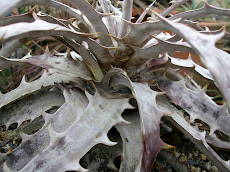
Isn´t it pretty? The leaves under surfaces are white/silver.


Dyckia brevifolia


Dyckia brevifolia is a reofitic species.
Here you see one Dyckia fosteriana-Sengés, the silver one and
a neophythum just to lend color.
The bigger Dyckia brevifolia is the natural variety Izabel.
Found in 1983 just after a Terrible flood of the mighty Itajaí-açu River.
The plant appeared adrift in our particular river beach.
It flowers during autumn while Dyckia brevifolia flowers in spring.


Dyckia brevifolia
Maybe the most classic of all dyckia species.
Dyckia brevifolia Izabel flowers during Fall and no one know its habitat.
Some say it comes from upstream in Salto Pilão and Rio do Sul in Santa Catarina.


Dyckia sp Três Passos- RS


Yes, it looks like one Dyckia fosteriana but it is not.
It come far way from any Dyckia fosteriana.
Comes from Northwest Rio Grande do Sul.
Look the spines, they are closer to one another.
The flowers are a deep yellow and not orange.
Rosettes are shallower and the plant is even much more beautiful.
Rare and undescribed.

Dyckia ferruginea


This is an impressive plant.
Those who like the silver this is it!
Not all Dyckia ferruginea is so silver but they are all impressive.
This species has not learned how to fly. Comes from Mato Grosso Cerrado.
This one here have much to improve.


Dyckia beateae - One of the most outstanding Dyckia


Dyckia beateae conquered my heart by the first glance.
Outstanding!
Colorful leaves, big teeth, nice size, but in order to be so this Dream Dyckia
demands sun! Rich and direct sun for at least 10 hours a day.
If no so the plant turns into a pale imitation of this, a drab faint creature.
Enlarge this picture and search for the flower stem just beginning to be emitted.


May 14, 2009

Dyckia sp Campo Tenente-PR


Dyckia fosteriana affinis?


This is brand new! This is an intriguing new find from Southeast Paraná. It seems to guard some looks of the Dyckia fosteriana. The flowers are reported to be orange and very similar to those of the Dyckia fosteriana. The Southermost Dyckia fosteriana was found in Lapa some kilometeres North but even so too much too south for a fosteriana whose range was understood to be two hundred kilometers North. Well this may be not any sort nor kind of Dyckia fosteriana but it looks a green one. Think it is one Dyckia fosteriana affinis or something like that. It is new and it is too soon to state anything. The plant is rupiculous and far away from abundant. This plant was loose and fallen from the rocks. this a discovery from a friend of mine and cultivated by him since last January.

May 13, 2009

Dyckia Dona Brasília


Dona Brasília is my beloved sister who lives
way deep into Paradise waiting for me.
This plant is an hybrid, and one in some thousands seedlings.
Dyckia marnier-lapostollei blooms in autumn and Dyckia brevifolia blooms in spring.
One Dyckia brevifolia all of a sudden produced two little flowers in may our autumn time here.
Brasília is my beloved sister´s name.
She died attacked by a most terrible cancer.
She was an Educator and always said The best way for a man to get close to God is by
knowledge and love.
Light, Light shine upon the brilliant minds on Earth!
We must win cancer!!!!!
Hunger, hate must be combated.
This she trusted on...
I miss her...
Here the plant is ready to be shown during an International Exposition.

Dyckia sp Colider-MT


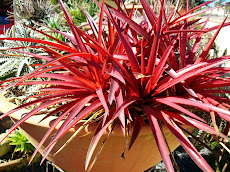
This species in my opinion, is the brightest Dyckia species.
This shinning beauty comes from North of Mato Grosso and there is a
natural variety that is breathtakingly red.
It is a small not dwarf plant never seem outside Brazil
I is a weak flyer and a bad swimmer.


Dyckia minarum


Dyckia minarum comes from Minas Gerais as its Latin name indicates.
It seems every Dyckia species has its own weirdness...


The strangeness this species presents is the absolutely hate it shows off regarding to transplantation.
When you transplant a Dyckia in benefits from this and gain new vigor. Dyckias are fond of transplanting except this one here. When it doesn´t perish it takes ages and ages to recover.
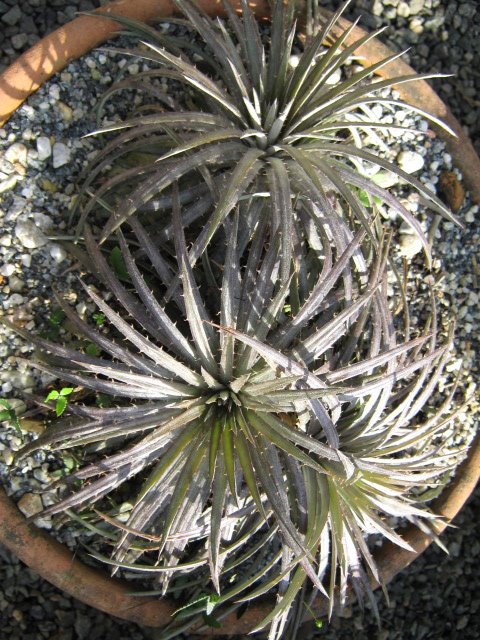
So do not touch the root system here when transplanting . Cut or break the vase and to the transplantation in a very "mild" way... and do it when it is absolutely necessary.


Dyckia ibiramensis and Dyckia fosteriana


Two absolutely rare species get together here to get even better together.
Some angles may be weird and odd to the point of view of an expert photography lovers but here.
I tried the point of view of a Dyckia lover...see the strange...
Dyckias are absolutely gorgeous new found plants.
Some have nice flowers but they are show plants even without flowers.

May 11, 2009

Dyckia goehringii ( The ivory Dyckia)


Yes, it is species! Yes it is special!
Yes, it is a wonderful good looking plant.
The silver white scales are so tiny it looks like a wax coat.
Looks like carved into ivory.
I it had not a name it well would be Dyckia goehringii eburnea.
Now enlarge this picture below. Note a beginning of a flowers stem.
It is the first time and it alcove companion already flowered so
it won´t be possible to produce pure strain here.
It will make love to a plain ordinary just beautifull Dyckia goehringii one of those red/wine silvery big toothed plain Dyckia goehringii. The seeds will be pure strain but not eburnea as this one...but..maybe....maybe.


The Explendour of the Rocks....


Dyckia sp Perau da Cabrita - SC
Yes this is a species. Yes it is natural.
No, it is not a Cerrado plant. It is a Southerner one.
Comes from Santa Catarina.
It is not small but also it is not huge even though you can´t put it in your windowsill.
Click on the pictures and... and... drool buckets, no one is going to blame you for that.