Mar 4, 2009

Am I Dreaming?


... for sure! Dreaming and snorting out loud...
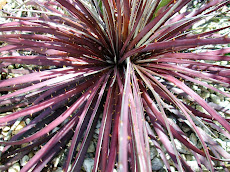
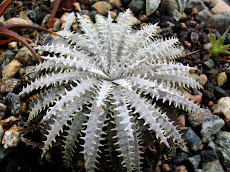
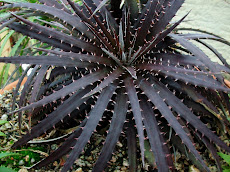
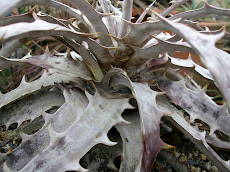
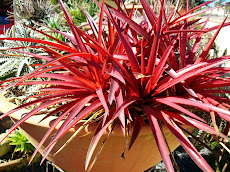
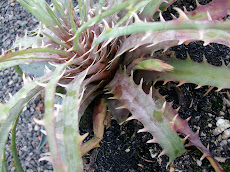
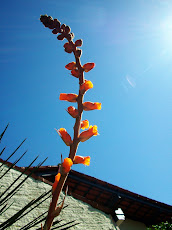
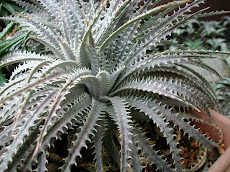
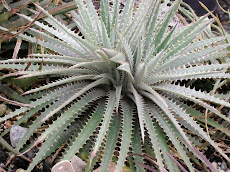
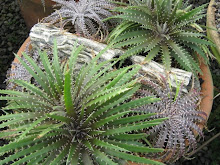
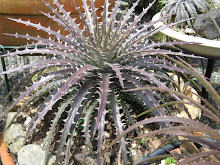
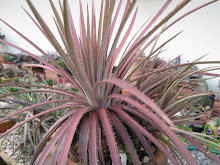
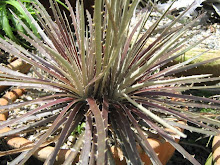
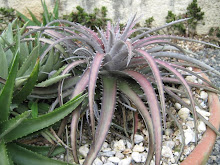
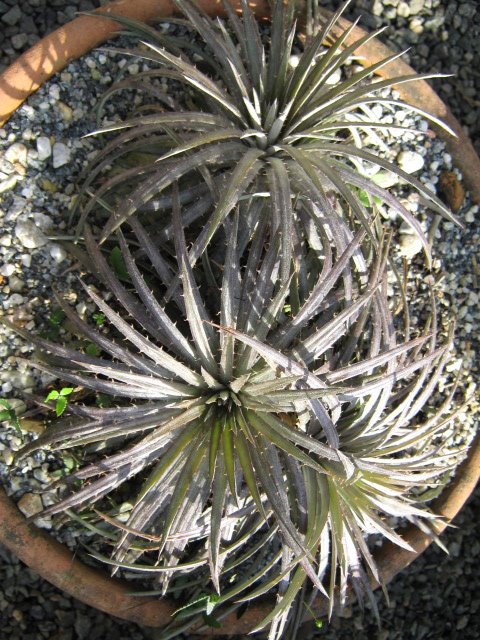
This is a Dream Hybrid Dyckia...a Dyckia Lad Cutak descent.
Mr. Ladislau Cutak had begun...
Dream! This one came from the end..from the end of the rainbow....


...a place to be called Home.


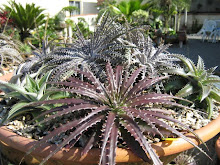
Just planted pottery basin.
Dyckias must have room at their disposal to be good looking.
They easily get dwarfed in confined rooms.
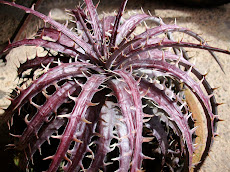
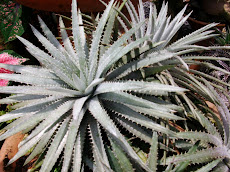
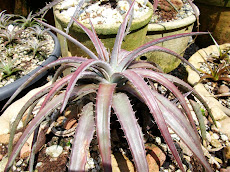
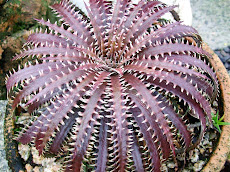
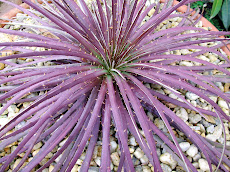
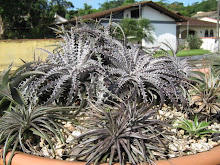
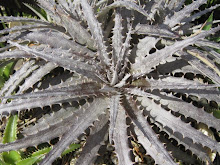
These are Dyckia grandidentata, the new jewels from Mato Grosso.
You can see some seedlings of it too.
Let us follow how and why this "home" was built:


Provide room for your Dyckia.
Dyckias have a huge root apparatus, a strong network that reach every hidden point searching for food.
Roots enjoy to hug all the drain material where they breath and feed on nutrients washed from the substrate above.
There they find air, humidity and the freshness they need as a refuge place in those torrid hot days...( Now imagine small black plastic pots...getting the sun of yesterday..when the therm sensation was above the fifties degrees centigrade in shade.)


Drainage is the main focus here. Dyckias take rain, they love it but they need plenty of drainage. The water may not take long to follow its destiny. Pottery is the finest choice, porous, natural, recyclable up the end...


Substrate must be aerated, light, nutritious, organic, acid.
Acidity is crucial for the Dyckia development. Watch out your water. If you use naturally acidified water Dyckias will applaud you. Peat is an excellent material to safely acidify the water.
Tap water may be the very reason for one Dyckia not to succeed. The acid substrate and a basic water built up salts that little by little remove all the good looking characteristics of a plant.

These Queens are no more homeless...a castle, at last!


...and they have a roof over their crowns, ups! It would better say a floor under their feet.Remember, these Royalties got homeless after the wind had destroyed their castle.How does they look like sit in their throne?
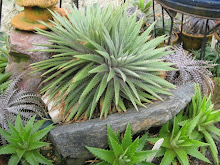
Their Majesties Dyckia lindelvaldeae in new their castle.

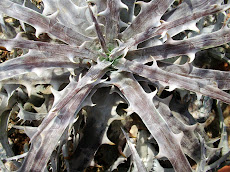
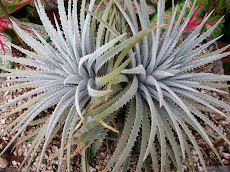
Dyckias from the Dyckia hebdingii complex


Dyckia domfeicanensis and the little perfection Dyckia hebdingii
related neighbours.
Similar but no equal.
The first one is bigger while later is much smaller and blue hued.


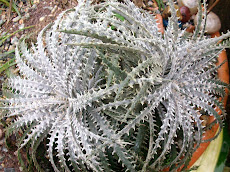
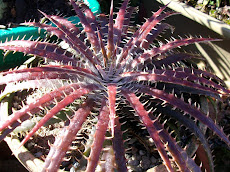
Above and below Dyckia ebdingii


Here below the biggest from the Dyckia hebdingii complex.
Is it already named? It is not for me to know, It is going to take a while
to get to know this.
This one is about blooming.


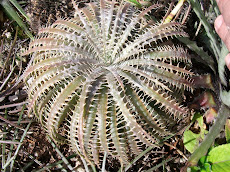
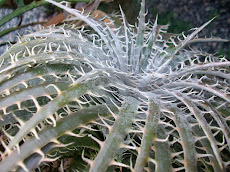
Below you will see three pictures with Dyckia hebdingii grandis.
This is a superb plant.


This Dyckia area should be better studied and understood to preserv it or better use it. Large plantations of strange trees, pinus and eucalyptus, for timber and paper making and also trees to produce tannin for the leather cure, acacia, as well as ignorance and cattle raising all get this plants into perish and endangerment.
But what would survive to the night of not knowing?
Darkness, true darkness!
LIGHT!
Let us put it on the table to illuminate to brighten minds.
LET US BE LIGHT!!!!

Dyckia domfelicianensis


Dyckia domfelicianensis is close related to Dyckia hebdingii and
one can´t tell who descended from who. Dyckia domfelicanensis is bigger and never as scaled nor so much silver blue hued as Dyckia hebdingii.
They live close to one another in nature and you can easily cross on foot the distance between them.


We can state, Dyckia domfelicianesis belongs to the same Dyckia complex
as Dyckia hebdingii and Dyckia hebdingii grandis and some more Dyckia sp.
The extension of the Dyckia hebdingii complex is not known yet and it may include some
more brand new to science spiecies.
All this complex lives on a very poor coal mining area of Rio Grande do Sul.
The coal here has a very low quality and another enemy came to
destroy what mining could not achieve: The eucalyptus plantations.
Do not get fooled Dyckias will survive but only in high quality collections.
Even those collections ( when existent) in Public Botanic Gardens that should be the first to guarantee the survival of these gems can not do any good. They change politically every few years and researches and scientists get lost.


Mar 3, 2009

Dyckia lindelvaldeae - that´s a true Dream Dyckia for sure!


Even the green one gets a new look by Her majesty side.
Here a Dyckia brevifolia ( a hint of it), a Dyckia fosteriana and in the background one magnificent Dyckia Marnier. No, not the one you see, no Sir! That is a king Dyckia marnier from Goiás. (...and as He is a King here you are allowed to see just the undies, OK?)
The star here is Dyckia lindelvaldeae.


Yesterday Her Majesty faced the storm of her life and here it is...
(Just shaked the feathers, as a bird.)
Water, wind and thanks God no ice cubes (hail). This would destroy it.
All Dyckias are much to sensible to hail even if mild. The got horrible marks all over. It is too much too risky to maintain Dyckias in open skies as I am doing.


Here she is sharing room.....a royal maid.


Here she is just ordering...ordering the Sun to Shine and shine bright...
Dyckias, baby, are extreme sun lovers... there is no too much.
Imagine 45 degrees centigrade in shadowed place...and dyckias were vibrating...


Homeless Queens!


The Homeless Queens
Dyckia lindelvaldeae - Their Palace cracked into pieces

Yesterday, the temperatures hit a record mark here in Northeastern Santa Catarina, Brazil. the mark touched the 45 degrees Centigrade with 99% of humidity in the air. The sensation was 53 degrees Centigrade. this is melting in Dante´s inferno. At the end of the day a windy thunder storm caused some injures to my garden. Nothing that some new pottery can not rescue,save and solve . But the wind left me with no energy till midnight. That was when the real thing begun. Imagine more than 40 degrees centigrade and no energy. No light, no air conditioner, no sound, TV, reading...and in spite of everything This morning I had to deal with this TWO HOMELESS QUEEN. Their palace blown with the wind and by miracle they are in perfect conditions, like they had just a bad dream..a nightmare.

Mar 2, 2009

Dyckia sp Pedreira - RS


Still on construction this Dyckia arranjamente has being made to impress.
Those two babies are Dyckia sp - Pedreira-RS. they get spherical and compact
the size of a football ball.
Structurally it reassembles the compact and magnificent Agave victoria reginae.
It comes in a balanced green /silver hue.
Today the temperature rocket the skies and went well after the fourties centigrade.
Thi is a huge pottery basin, perfect for Dyckias this size.
In the back you see one silver Dyckia sp Cachoeira Dourada, another super star.
Hope they turn to be confidants as they share the same room.


Today it is the warmest day of the summer, just 41 degrees centigrade.


One thing is for sure, they are relishing every sunny ray, appraising them,
enjoying the sun bathing.
uuuuaaauuhhhhhh!
... give me a break ...


March, 2nd - 2009 - Joinville - Santa Catarina - Brazil
It is 1 pm and 41 degrees Centigrade! It will raise a bit more till 4 pm.The therm sensation goes for 46 now ( and up going)! This sensation may touch the fifties.
...and the dyckias? All in the sun, drinking it, savoring it, loving it.
They, in fact need this super hot weather.
Here, in wintertime we may have some sub-zero temperatures but just for a very few hours.
The snow may appear uphills some 60km from here even so when it comes it is a happening.


Dyckia estevesii apiral leaved


Well, after much confusing finally the right thing or the truth comes to the surface
of a muddy bog of errors.
This is the plant that generates Dyckia estevessi the fan one.
The fanning is a phenomenon much like the crestation in cacti.
Not all plants are fan like just some.
Fan like plants are sterile.

We were induced to think the plant were not self fertile and as never two plants fan leaved crossed we thought they were clones from the same mother plant in other words the very same plant.

The spiral form is self fertile! It has some problems in culture concerning to fertility bur it is self fertile indeed.
It is from these seeds, seeds of the spiral form that the disdichous form comes in certain percentage.
Being so what we conclude?
We conclude the one who described never was in the habitat of this plant and this is a mistake.
Long ago Taxonomists rely only on bush men and collectors. Taxonomists would never dare to come to the tropics and face the mosquitoes and indians and snakes and such and such..
this was long, long ago...
Also ?Dyckia descriptions were made without the full observation of the plant, the living creature in habitat and in cultivation.
What was the hurry here?
Humm...Did the taxonomist knew about the spiral plant growing together with the fan form?
Was he told about?
When did he came to know?
What was done since then?
Errors and mistakes are much too human.
We are not perfect creatures.
I think this is great and we learn a lot.
We ought to observe this and this fan manifestation.
What induces to this fan form?
Is it something to do exclusively with genetics or this is something induced bu some agent?
Also in late sixties the region was the scenery of a Brazilian civil war. The military men took the power with the applause of America. They gave the power back 30 years after.
This is over, Amen!


Dyckia estevesii - The fan Dyckia


The fan Dyckia is an exclusive Dyckia.
I t seems we have one other fan Dyckia species here in Santa Catarina
close the where Dyckia ibiramensis comes from.
Dyckia estevesii is a magestic Dyckia.
In spite of being green its green shade is incomparable to any other Dyckia.
This guy is not fertile.


Now, imagine a red form of this or a totally silver one with even bigger spines.
Everything is possible in Dyckias. All one has to do is dream...


The plants tend to incline by themselves.
This is a way to get rid of the water stuck between
the leaves. This would be fatal to the plant.
So do not keep them uprighted.
They are very good swimmers and fliers and already crossed the Seven Seas.
This species and Dyckia beateae used to fly hand in hand.

Another gold medalist for sure.
This form is very prolific in clone making that is why it is fequently seen.

Mar 1, 2009

Dyckia Brasília


Dyckia Brasília
I had a sister... named Brasília. She was named long before the new capital turned to be.
She was the one to assist me growing, coming out from the baby to the boyish times.. younghood and being a man.
She was my angel and I miss her.
This plant is for her. This hybrid of my own bears her color green and pink as the color of that famous Rio Samba School Mangueira.
Dyckia Brasília has the colors of Mangueira, green and pink.
So, this is for you my guardian angel
Brasília, my sister.


Dyckia Brasília is one out of a thousand seedling resulted from
crossing Dyckia marnier lappostollei and Dyckia brevifolia Izabel.

Another Precious Gem From the End of the Rainbow


Dyckia julianae

Sure thing to find at the end of a rainbow


rainbow

Dyckia grandidentata


Dyckia grandidentata
(We have seen bigger teeeth in fact much bigger!)

A newcomer from the scientific world.
We all have much to be observed in here.
For sure, it is a very beautiful plant.
This one here has much to go ahead to be gorgeous but it sure will.

Dyckia ferruginea - Big and Beautiful


Dyckia ferruginea
Big and bold and beautiful.
Some individuals are completely silver.
Even amid hundreds of different Dyckias no Dyckia lover fails
to see it.
Yes, it s boldly conspicuous amid anything.
A sight to behold.
A true challenge for the Southern Dyckia keepers. It must have fierce sun and do not tolerates a poor drainage.
Poor lousy drainage, high humidity, South coldness and few hours of strong healthy sun light ( winter days) are the fatal combination! It melts right away....and you cry.


Dyckia encholirioides multispina


Dyckia encholirioides multispina
This is a bit smaller than the immense Dyckia encholirioides
even so it is huge and doesn´t fit in ones windowsill, even a king sized one.
Smaller and prettier! Look at it.


Dyckia encholirioides - that may be huge!


Dyckia encholirioides
Definitely not for the windowsill.
This one may get huge!


This baby enjoys to listen to the sea.
Its spines are not so close to one another like in the multispina variety which is a bit smaller.
The container here is a 1,5 m wide mouthed one.
It is appropriated for a very well equipped public botanic garden.
There it would be a center piece, an eye catcher.
It is one of the longest living Dyckias. Individuals of hundreds of years were found.
It is a restinga (a close to the sea habitat) inhabitant. Thrives on fine sand and on the rocks receiving salt water sprays all the time listening to the come and go of the Atlantic Ocean waves.

Dyckia ibiramensis


Dyckia ibiramensis

That is as rare as a black breasted penguin or a polka doted zebra.
Meanwhile it is the maddest dyckia about sprouting and cloning itsel.
It does that by the cents.
Flowers in yellow and the seeds germinate without any trick.

A Red Silver Member of the NSCHDC


Maybe the most silvery Notheastern Santa Catarina Dyckia.
It is a gorgeous member from that Dyckia Complex


Dyckia hatschbachii - A Dyckia species from east Paraná.


Dyckia hatschbacii
Resembles an extra, extra huge Dyckia brevifolia.
The name comes after a Brazilian botanist.
flourish in yellow blooms attached to a strong flower stem.
Have you seen one of this?