May 7, 2009

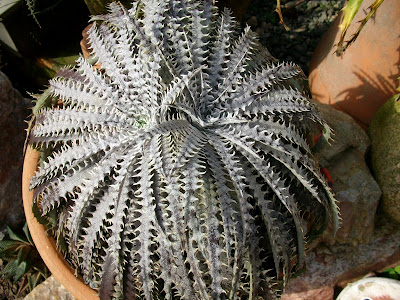
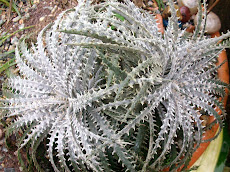
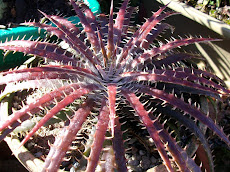
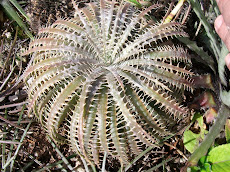
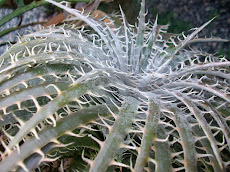
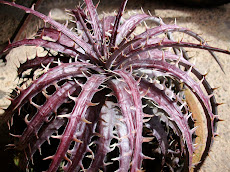
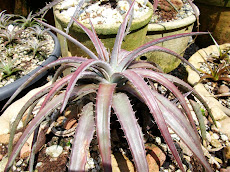
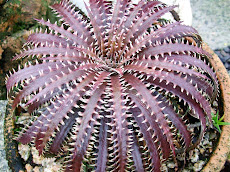
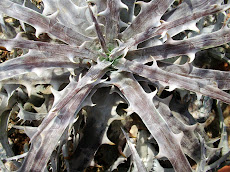
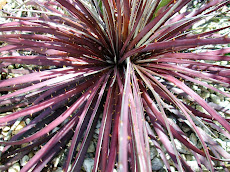
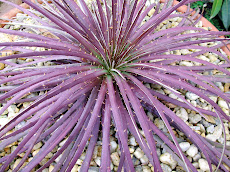
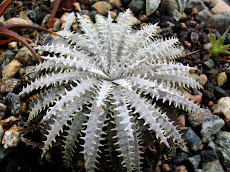
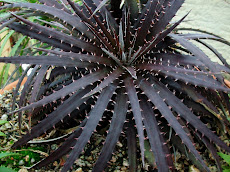
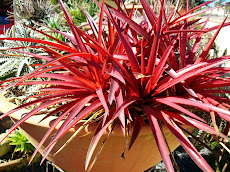
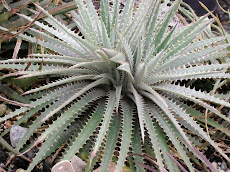
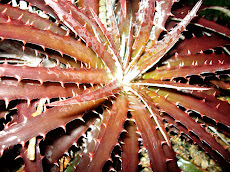
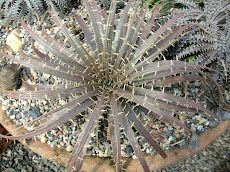
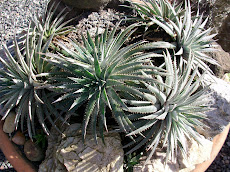
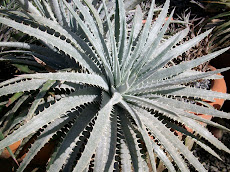
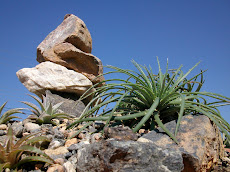
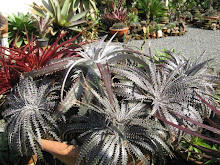
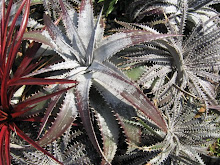
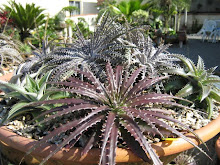
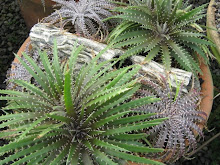
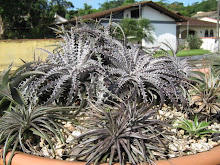
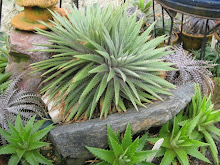
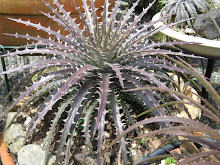
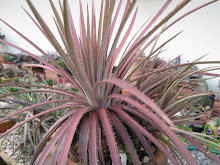
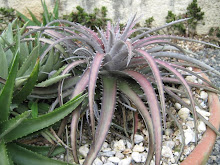
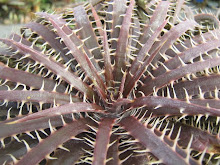
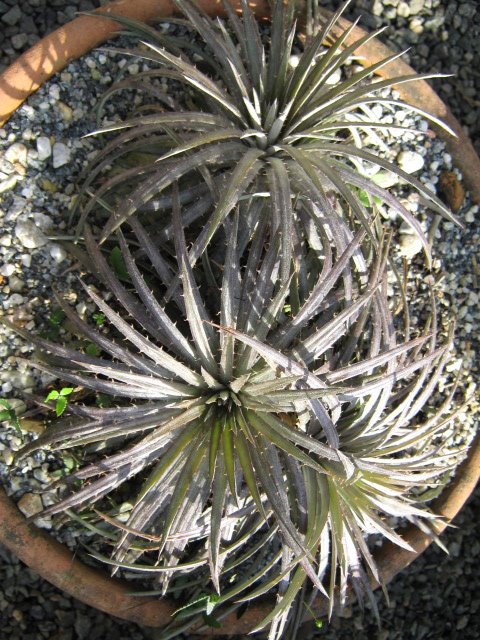
Dyckia dusenii - rubra form


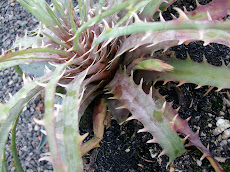
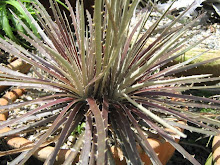
Dyckia dusenii - Olive rubra form

Some Dyckias have a big array of rubra forms and not all of them
is red.
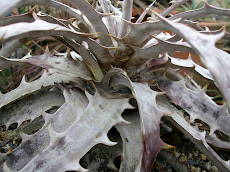
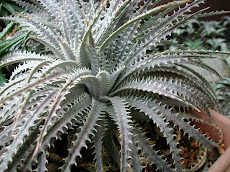
Dyckia Dussenii bears stiff straight leaves and the contrast between both leaf surfaces
is striking.
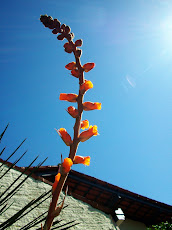
also, this species produces very beautifully flowers. Dyckias are not always good in flowering. but this one here bears flowers to suit the cut flowers commerce.


These are early morning shots so dew is covering the foliage.


May 5, 2009

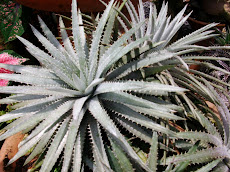
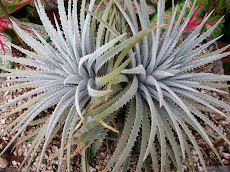
Dyckia matogrossensis


Dyckia matogrossensis is a medium sized one.
It is not a fancy plant and its looks are those of a grass clump.
I say a " capinzenta" or looks like plain grass.
Nothing that a bit of a Dyckia marnier´lapostollei pollen can not solve.
Maybe a Dream Dyckia may come out from such a beast.


It seems to be a Dyckia estevesii related species.
Flowers are equal as those of the Dyckia estevesii.
Also some Dykia estevessi hybrids look much close to this.


Dyckia dom felicianensis


Dyckia domfelicanensis is another marvel from the Dyckia Triangle in Rio Grande do Sul.
It is Dyckia ebdingii close related. It is bigger than that.
A nice Dyckia plant still to be seen abroad its home land.
Rare to extremely rare even here.
This Dyckia Triangle compresses A large territory in between Arroio dos Ratos, Dom Feliano and São João do Triunfo. All small towns not exceeding 10 thousand souls each one.
Also there are huge pine, eucaliptus and acasia plantations besides being a coal minning region.
Everything native in there is in great danger of extintion.


Rio de Janeiro Native


This beauty lives on the second highest mountain of the entire Brazil.
It is a Dyckia pumila affinis.
Besides this everything is cloudy about this species, as its habitat.


Bathed in dew


Dyckia reitzii type form and Dyckia catharinensis type form
Enlarge by cliking on the pictures to see all the beauty here.

Here you see these plants by the break of the day and bathed by the dawning dew.
Dew is an important source of water and may be the only for months in a roll.
Starry nights, when clouds are far way, the air use to be cooler.
Cold starry nights preceded by warm bright day are essential to form dew.
All hot surfaces when touched by the cool night air produces a cover of dew
Dew water is very import for rupiculous Dyckias and may be the only significant source of water available in months.
Dewed mornings precede magnificent blue sun shining days.
Dew brings the magic and the joy of life in wilderness.
These two plants here are soaked in dew water.


May 4, 2009

Rubra form and red phase are distint things:


Above you see the rubra form of the green plant below.
The only green area is the growing center of the rosette.
This species is a Santa Catarina native.


These are Northeastern Santa Catarina native.
Here you can see the rubra form.


Red phase are quite common among Dyckias. Many Dyckia species show this redness when induced to it. Dryness and fierce sun strike this effect on Dyckias. This is the red phase. Red phase is not an eternal mood, once watered and the sun amened the plant turns again to its green phase. The red phase is a protection. There is another and definitive shade of red in some Dyckias species. This is the Red Form or the rubra ones. This is forever like diamonds and do not fades away or turns into a faint hue of red. The rubra forms holds their redness year around. Not all the species present the rubra form. Dyckia brevifolia has no rubra form. There is an accepted fake Dyckia encholirioides rubra form. Here the rubra refers to a red spot on the petals, the plant is as green as all Dyckia encholirioides. Here you see some rubra form and they are close to the green form. Note if this was a red form only, every plant should be red. As it is a true rubra form only those are red.


May 3, 2009

Dyckia ibiramensis


Dyckia ibiramensis
Securely the rarest Santa Catarina Dyckia.
It is a reofitic one. Grows on a rock close to fast running white waters of the Hercílio river in the outskirts of the charming Ibirama City in Santa Catarina.
The region bears some other Dyckia species as Dyckia brevifolia and two others.
The white/silver plant is a selected Dyckia fosteriana or one in a few thousands Dyckia fosteriana seedlings. Enlarge to see it in detail.
This in my opinion is the best way for bettering a plant ´cause you do not hybridize it.
Selection is the best choice to find a Dream Dyckia and also getting pure strain.

Dyckia sp Três Passos - RS


This is a Dream Dyckia for sure.
Click on this image to see it in details.
No, it is not a Dyckia fosteriana!
It is a wild plant from Northwest Rio Grande do Sul.
I only know it comes from there and from a cliff a rocky cliff.
It tends to stay this way perpendicular rosettes.
This avoids water in the center of the rosette.
It is a bit larger than fosterianas and the flowers are bigger and attached to a more vigorous spike and the color of the petals is paler when comparing to those of the fosteriana from far way from it in Nothern Paraná.
The spines are rubber soft and than one told me it was Dyckia delicata but , of course it is not!
A Dream Dyckia still to be known.
I am particularly fond of it.

Dyckia fosteriana lapeana nivosa Lapa - PR


Dyckia fosteriana lapeana nivosa
The name is a suggestion

It may be the southernmost occurrence of Dyckia fosteriana.
Comes from Lapa in Centraeast Paraná.
It is a smaller plant than all Dyckia fosteriana.
Lapeana meas from Lapa and nivosa means snowy. The plans gets the top much more whiter than the rest of the plant. The rain removes the white scales so the top or the growing area is most commonly whiter than the rest of the foliage.
A rocky beauty.
It was found among Parodia cacti in the middle of a fig plantation. It is well protect or at least this population.


Dyckia fosteriana - Paraná


Dyckia fosteriana
Emboque - Paraná
Close to the São Paulo border

Above


Dyckia fosteriana - Sengés - Paraná
Above


Dyckia fosteriana - Emboque Region in Paraná
Type plant

This is one old lady we slhoul say a classic Dyckia. It is known by anyone on Earth who loves Dyckias or they think they know it.

Most of the time what we see is a drab faint plant with some Dyckia fosteriana blood in its genetic line.

This is undoubtedly one of the most beautiful plants in the Dyckia World a cadillac Dyckia and the reason for so much confusion lies on these facts:

a - All Dyckias are very hard to be recognized. They may have many, many faces. Thi leads to many errors and mistakes.

b - Science when in a hurry to come into a conclusion committed many mistakes, some historical ones.

c- This plant occurs in several locations hence some variations in its appearance.

d - As most Dyckias this one blooms easily and also crosses easily. One plant may look exactly as one Dyckia fosteriana and yet be an hybrid so the descent may never be as the parentage in spite of look alike.

e - The plant may be totally reddish and with just a few scales when under too much heavy rain. The water washes away the silver scales and what is left is a reddish or simply red/greenish/wine color plant.

f- When in months of no rain or no heavy rain at all, what occurs sporadically in its habitat, the plant is an allover silver jewel as the one you can see below.


The above plant comes from Cambé in North Paraná.
It is a very silvery plant and its silver scales are tiny.
That is a luxury Dyckia fosteriana.


Above Dyckia fosteriana from Arapoti/Jaguariaíva Region in Paraná

After seeing these pictures you may realize that what we see under the name of Dyckia fosteriana is hardly to a real fosteriana.

There are many more reasons beyond those above for the fosteriana caos happen and I do believe that the main reason as ever might be something too much too trivial: money!

People get open fertilized seeds from a plant that look to be one Dyckia fosteriana and states or worst yet sells the seedling as legitimate fosteriana.

We see this with some other species as Dyckia brevifolia and Dyckia marnier-lapostollei.
The longer a plant is abroad, the rarer it is and the most beautiful it might be the more strange it gets as the time passes by.

Each species with some particularity added has appeared a bit strange to the real one. Marniers do no self fertilization and they have many faces so "varieties" are created instead of the true species. So we use to see as much variations as star on a winter starry night sky.

I do believe that soon we come to a point of hardly find something true in terms of species abroad Brazil and in some cases even here.

Money commands.
I happened with orchids, cacti, bromeliads and now it is happen again with Dyckias. History repeats itself.

How do you think we find an extremely rare and protect by law species being on a sale outside Brazil? Do you think the plants use to fly like migratory birds or swim with the whales and the sardines?

I do not mind a bit, I think we might have rare plants cultivated in exhaustion around the word.

The point is...when something is real rare and illegal and money is all around...hardly if ever honesty follows and then a pony is a zebra.

...and when honesty is rarer than a Dyckia beateae ( there is just one spot for it in wilderness) what or who do you trust on?

When the roles are distorted what to you have for guidance, what lighthouse your ship follows?

Nothing is yours nor mine but ours! We should understand that clearly.

There is none to blame for the burning of our Amazon but we all, all of us with no exception.

Those who feeds on beef and do it of a fancy tropical wood made table are those to blame too.

Our little world is too much too different now. Home is only one! We are all neighbours. Listen, your dog is barking.

Take my hand... as that song: Take my hand, I´m a stranger in paradise. I´m lost in wonderland..a stranger in paradise...and if I stand stared eye..that a danger in Paradise.
Frank Capras´ Lost Horizon
Our Shangri-la is here, there and everywhere.
Let us all do for a better place.
Understanding is a very good way to do it.
Knowledge is as a Lighthouse...

Dyckia julianae - Arroio dos Ratos - RS


Dyckia julianae

This is a true charming species.
Comes from down South in Brazil.
Arroio dos Ratos belongs to something like Dyckia Triangle.
There we may see some of the most striking Dyckia species.


Small and every well arranged and symmetric rosette.
The color varies with the season and the humidity at its disposal.


Bears small yellow flowers attached to a slender spike.
It turns into a pinkish/red shade of color when dehydrated.


New breeze from the South


Dyckia sp Pedreira - Viamão -RS

A nameless species
Comes from Rio Grande do Sul.
Lives on a granite rock that has being cut piece by piece to make grid
for the construction industry.
Another species lives there with impressive black spines of more than 2 cm long.
Grows compactly up to the size of a basket ball.


The rosette center gets violet!
There are individual plants absolutely silver.


Produces a very string flower spike with thousands of minute yellow flowers that later produce uncountable tiny seeds like bird seed.


Red, red, bloody red


This ribbon like leaves Dyckia is absolutely new and comes from Northeastern
Santa Catarina in Brazil.
Its flowers are a sight to behold being very conspicuous and charming.
Normally Dyckias produce drab meaningless flowers and rarely one may have its bloom recognized as beautiful.
This plant has a red or rubra for and not a red phase.
The rubra form is always red and the only green point is the growing area in the center of the rosette.
The contrast between upper and lower leaf side is striking in both forms.


May 1, 2009

Dyckia sp Perau da Cabrita - SC


No, this is not any Cerrado Dyckia!
This beauty comes from Southwest Santa Catarina way down south in Brazil
A Dream Dyckia!
A queen of the Queens!
Astonishing in my opinion nothing compares to this.


Ultra, hipper rare and absolutely new.
It was seen thanks to the efforts hydroelectric plant construction company.


Lives on a high granitic cliff of the Canoas River.
The plant was literally unreachable before flooding of the area.
Surprisingly magnificent.
Bears thousands of tiny yellow flowers that produce minute seeds.


The new discovery Dyckia sp Vila Cristina - Caxias do Sul - RS


This is one huge Dyckia that can reach 1.8 m high
and when blooming it gets more than 3.0 meters high.
Comes from South.
Grows attached to a granitic cliff just in the outskirts of the lovely
Caxias do Sul.
The place is very cold in winter and snow is not rare in there.


Note the two color spines, white above and black from below.
Impressive new Dyckia, new Dream Dyckia.

The colorful Dyckia beateae demands good sun to be magnificent


Dyckia beateae
(click on the images to see details)

This lady has everything a Dyckia needs to be absolutely magnificent, big spines, imponent size, contrasting colors and a good architecture.
To achieve this appearance and get this look the plant needs enough good sun. It does no deal, or the sun is at plenty or it fades away.
Without it it turn into a drab faint shadow of this majesty an eve very young seedling are colored this intense or even deeper colored.


The Stinking Lady from The Central Brazil Rocks


Dyckia lindelvaldeae

One of the prettiest Dyckias. Has all the attributes a Dream Dyckia may have and a plus....
This is the most scaled Dyckia of all. This one here lost most of the scale to the rain.
It is small and fits anywhere.
It is rare and doesn´t self fertilize. Its seeds are small and tend to be very picky to germinate.
Its flower spike does not goes on rocketing to the skies up above as all Dyckias marniers.
The flower spike is short, slender and the flowers in spite not opening completely are good looking. They are deep, deep yellow almost orange.
...and this lady has a plus..it bears aromatic flowers.
Yes, aromatic but stinking.
Smells as rotten flesh, old cat urine and so on...
That´s why this Lady is a trap (...not a tramp, after all she is a Queen...)
Now look at this one here, one, two, three, four, five and six there are one more flower stalk amid the foliage. I need another Dyckia lindelvaldeae at blooming to produce true seeds...and I am the lucky guy, have three.
Dycka Brasília


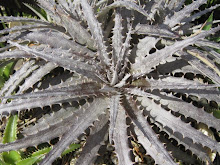
Dyckia Brasília
Dyckia marnier-lapostollei X Dyckia brevifolia
Looks like Dyckia hope but has less white scales underneath leaves
and the spines are beautiful red.

Dyckia Chão de Estrelas (Ground of Stars) nice hybrid


Dyckia Chão de Estrelas (Ground of Stars)
The pigamentation or the silvering dots reminds of a stary night.
Dyckia marnier-lapostollei X Dyckia brevifolia
Silvio Caldas and Orestes Barbosa were the authors of one of the most beautiful Brazilian songs, Chão de Estrelas. It refered to the marks the Moonshine used the left on the floor room when the Moonlight passed through the holes in the tin roof of the hovel a passionate couple lived in.
Chão de Estrelas!
Ground of stars!