Mar 30, 2010

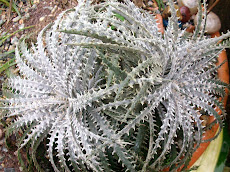
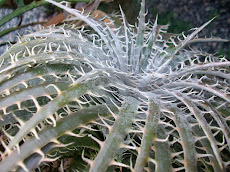
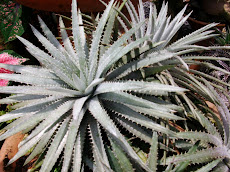
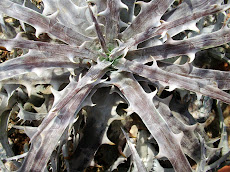
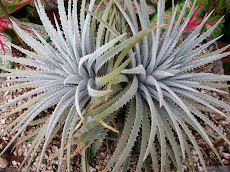
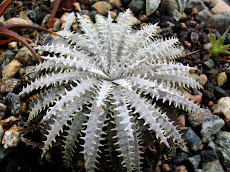
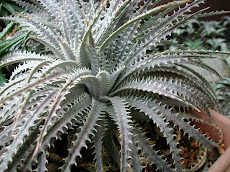
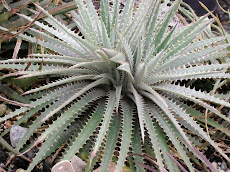
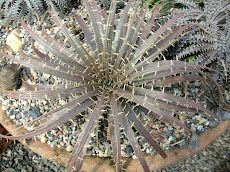
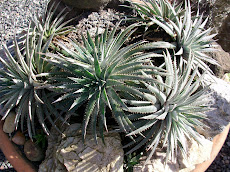
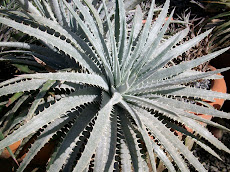
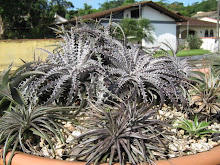
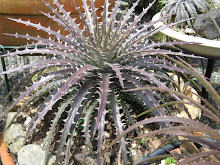
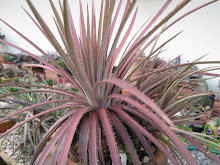
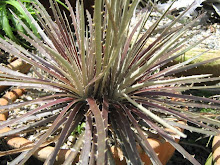
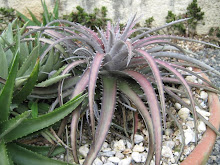
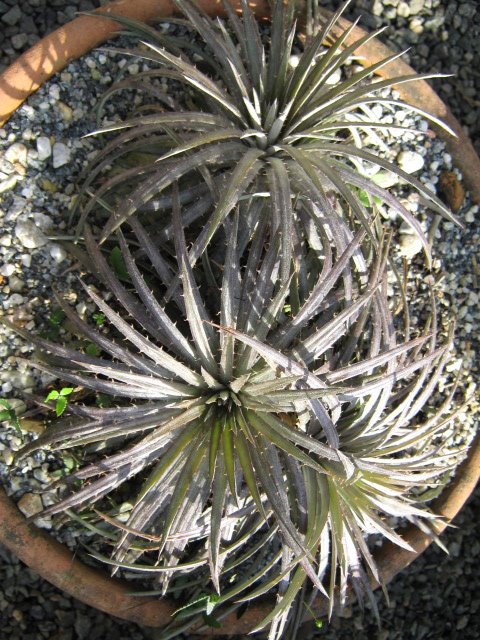
A new and beautiful new found species from Mato Grosso

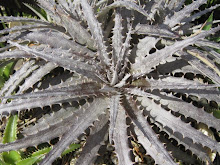
New extreme silver scaled  species from Mato Grosso.
This is a very dry  lover plant.
Plants with a deep silver coat tend to thrive in very dry conditions.
The silver scales help the plant to absorb umidity from the air and the morning dew.

Mar 29, 2010

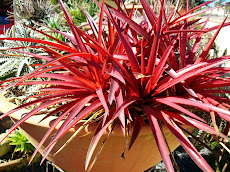
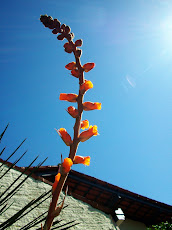
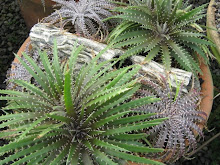
Dyckia companion ...Tillandsia capitata red

Tillandsia capitata red
This is acolorful Dyckia companion....

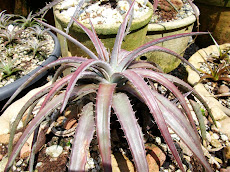
Species! East of Paraná South in Brazil

A mountain dweller.
This plant becomes much darker than this one here.
The darkening occurs in the winter. It would be expected the contrary but
against all odds this plant turns dark during the shortest days of the year.
By the end of the Autumn the plant is almost black.
Some individuals may as well hold the color all the time and once they get dark they stay so.
We know almost nothing about this species. It occurs almost on top of  an East Paraná  mountain where backpackers use to go. The spot is a very turistic (mountain climber backpacker tourists) one and the movent is quite intense up there.
People go by train from Curitiba half the way to Paranaguá early in the morning and them
return to Curitiba  by midafternoon also by train.
It is a very beautiful scenery fullfiled by canyons, valleys and intense greenery.
...and the plant lives there right in the face of everybody...unknown, unnamed...unseen but protected.


Dyckia species from Lagoão Region in Rio Grande do Sul

This another just found Southern Species.
The plant comes from a huge palette of colors that includes all the green hues, red, red/wine, silver/blue, chestnut/golden color shades.
Maybe all these color forms are perene and continues so through the year around.


Dyckia chorestaminea from the North limit of its range

This narrow leafed Dyckia chorestaminea comes from The Northermost limit of Dyckia chorestaminea range.


Dyckia Toothy Wolfgang - Bill Baker´s master piece

This is one of the prettiest of all Dyckia hybrids.
People use seeds produced by hybrid plants and this always results in a less beautifull seedling.
Hybrids only duplicates by cloning.
Cloning may be made in some different ways from natural head divisions, offsetting
to pupping and tissue culturing.
The only reasonable way to use seeds from any hybrid Dyckia is crossing again or bachcrossing with one of the parent plants.
As these  beautiful hybrids turn to be a very wished item in any collection they get rare and rare 
as they do not duplicate by seeds.
Being so the plant turns to be expensive as the plant itself must travel far.
Seeds travel infinitely easier than plants.


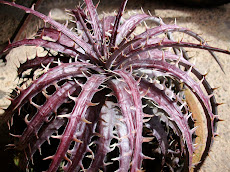
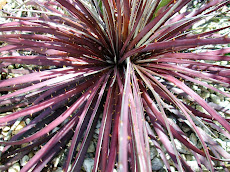
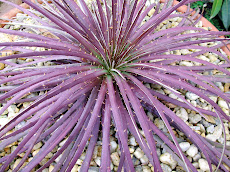
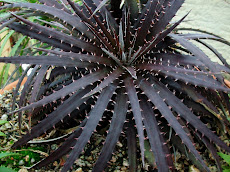
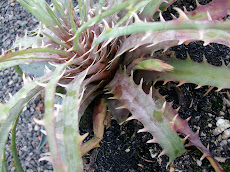
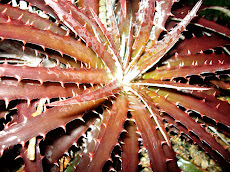
A deep dark new found species from East of Paraná

Dyckia species native to East  in Paraná.
The darkest burgundy color on a Dyckia species up to now.


Mar 28, 2010

The world most beautiful bromeliad, species or hybrid!

Dyckia gloriosa
Under the nocturnal rain
Nothing compares to this plant!
The most beautiful Dyckia of all species and hybrids I´ve seen.
The most spectacular bromeliad of all.
Nothing gets close to it!
this color is preserved year around.
The leaves have contrasting surfaces of pure strinking silver and a pinkish red wine.
Leaves are so long they fall under their own weight.
Spines are very far apart from each other and are golden.
Native to Northeastern Santa Catarina.
An only one found in such a color and form.


Dyckia fosterian rubra under rain

Dyckia fosteriana rubra
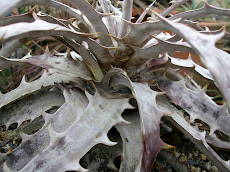
These plants are very silver and intesively scaled.
When wet the scales retain the water and show off the color of the plants.

Scaled plants does not like heavy rain. They even loose their scales.
These trichomas are used to reflect light and absorve umidity from the air and also retain dew.
This is why very scaled plants survive in much drier and hostile conditions.
Watch the watering when dealing with very intesively trichoma covered plants.
Silvery plants are much more apt to get water from the air so less water are needed.
This doesn´t mean the plant should not be watered. Yes they must!! ..but less.


Dyckia splendens Campos Novos - Santa Catarina

Dyckia splendens, the beauty under the nocturnal rain.


Dyckia gloriosa.....day and night

Daytime picture

"Day and night you are the one, only you beneath the Moon or under the Sun...
Night and day...day and night.." 

Nightime picture


Dyckia goehring and Dyckia pectinada plant and a Dyckia Burle-marxii ....AN AFFAIR TO REMEMBER...no doubt

Dyckia goheringii  x Dyckia pectinata
X
Dyckia burle-marxii

This is An Affair to Remember!
Both plants bear huge hooks and the second will increase size.
The first is arched downward and colorful, the second bears straight leaves.


Dyckia species from Rio Grande do Sul

Lives on a granitic hill that has been dismantled to make construction material 
and to be integraded to asphalt to pave the streets and roads.

Ball like shaped Dyckias are common in South.


Dyckia argentea - Minas Gerais

Native to Serra do Lenheiro - Minas Gerais
A rare and obscure Dyckia species.


Dyckia species from Painel in Santa Catarina

Grows attached to rocky cliffs that descent to  a white water small  mountain river.
It may be a reofitic Dyckia species.
The area is also one of the coldest in Brazil.


Dyckia companion ....Neoregelia carcharodon

Neoregelia Carcharodon Red
 Carcharodon is the scientific name of some sea sharks.
This plant certainly is not a species and the second name begins witha a capital letter.
Its the owner of a striking beauty.
Acdept the sun but never as eagerly as a Dyckia but even so it is  a good companion if
a less scorching Sunny position is arranged for it.
This is one of the best looking bromeliads.


Mar 27, 2010

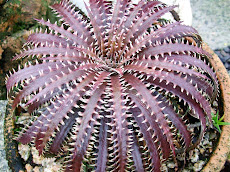
New Dyckia species from Paraná


This is a mountain dweller East Species from Paraná.
This is a young plant and adults can be even darker.
All green individuals are not known.


Two local Dyckia fosteriana varieties got together to achieve this result

Bettered fosterianas can get even whiter than this one here.

Dyckia fosteriana...the intense silvering is protected from the rain

The silver scales in these species is very loose and is easely washed away by the rain water.


Tillandsia fasciculata in Dyckia companion

T. fasciculata is a nice Dyckia companion.